

Introduction
Some books arrive at exactly the right moment. Into the Magic Shop was one of those books for me. Beneath its story of a young boy walking into a magic shop lies a profound exploration of how compassion, attention, and inner safety can change the trajectory of a life.
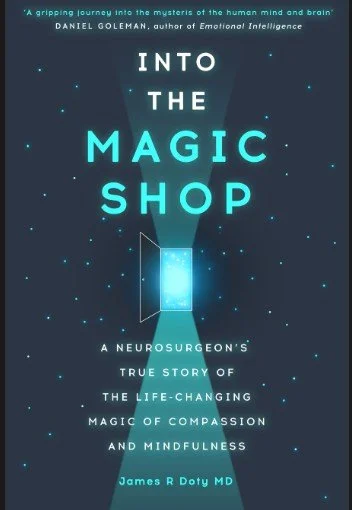
Into the Magic Shop is a heart-centred memoir woven with science, written by Stanford neurosurgeon Dr James R. Doty.
It tells the story of how a seemingly ordinary moment that Doty experienced as a twelve-year-old boy became a profound turning point in his life. He stepped into a small magic shop.
Emerging from a childhood shaped by trauma, uncertainty and emotional pain, Doty is introduced to practices of focused attention, visualisation and compassion. These tools would quietly rewire his inner world long before they shaped his professional one.
The book blends lived experience with neuroscience and mindfulness, and gently reminds us that when we learn to tend to the mind and open the heart, our outer reality begins to shift in response.
Summary
The memoir begins with Doty’s early life, a childhood shaped by poverty, an alcoholic father, and a mother living with chronic depression.
Longing for a little relief and escape, the young Doty wanders into a small magic shop in search of a simple trick. What he finds instead is Ruth, the shop owner’s mother, who introduces him to a series of mental and emotional practices that would quietly transform his inner world.
These teachings are centred on calming the body, training the mind, and opening the heart and go on to become the unseen architecture of his future, supporting his academic success and eventual path to becoming a neurosurgeon.
As life unfolds, Doty faces profound challenges, including a near-death experience and financial collapse, yet each time he returns to the same inner tools.
Woven throughout the book is a science-informed exploration of how mindfulness and meditation reshape the brain and heart, reinforcing a central truth of the book: healing and resilience begin within.
Chapters Structure and Outline
Rather than following a rigid instructional format, Into the Magic Shop unfolds in stages, mirroring the natural rhythm of inner transformation.
The early chapters focus on survival and nervous system imprinting, grounding the reader in the emotional reality of Doty’s childhood. From there, the narrative gently introduces the foundational practices Ruth teaches him: learning to relax the body, focus and taming the mind, open the heart, and clarify intention.
As Doty moves through education, medical training, and professional success, these practices resurface again and again, sometimes consciously applied, sometimes forgotten.
In later chapters reflect a deepening integration, where neuroscience and lived experience converge.
The final sections return to compassion as both a personal and collective practice, inviting the reader to see mindfulness not as a performance, but as a way of being in relationship with oneself and the world.
What Resonated
What resonated deeply was the reminder that success without inner safety is fragile.
Doty’s story illustrates how early nervous system conditioning follows us into adulthood, shaping ambition, drive, and achievement.
As someone who works with women who often appear successful on the outside yet feel exhausted and disconnected on the inside, this message resonated deeply with me. The book reminded me that achievement alone cannot create inner safety
The book speaks powerfully to the moment many of us experience: realising we’ve mastered external goals while remaining disconnected from the heart.
I was moved by the emphasis on compassion as a physiological state, not a moral ideal. The way Doty links emotional openness with nervous system regulation and heart-brain coherence reflects how I approach my work and life: when the body feels safe, the soul has room to speak.
Favourite Quotes
These quotes, for me, carried both tenderness and truth:
“I open my heart to a possibility beyond reason.”
A quiet invitation to trust something deeper than logic.“I had begun to let go of the story that had defined my life.”
A reminder that identity is not destiny — it is a narrative we can gently rewrite.“When you open your heart, you change the way you see the world — and the way the world responds to you.”
A simple yet profound reflection of relational neuroscience and lived experience.
Who This Book Is For
I would recommend this book if you:
interested in neuroscience and mindfulness
Are healing from difficult childhood experiences
Want a gentler approach to personal growth
Are curious about the connection between the brain, heart, and compassion
Enjoy memoirs that blend science with spirituality.
Conclusion: Why I Recommend This Book and Key Takeaways
I would recommend Into the Magic Shop to anyone drawn to the intersection of neuroscience, mindfulness, and soul-led healing — especially those who feel called to soften without losing their strength.
This is not a book about bypassing pain or manifesting outcomes; it is about learning to regulate the nervous system, reclaim the heart, and live from a place of inner alignment.
Key takeaways include:
Inner practices shape outer outcomes, not through force, but through consistency and presence.
Compassion is not weakness; it is a regulated, coherent state that supports resilience and connection.
Healing is not linear; we return to the same lessons at deeper levels as life unfolds.
When science and spirituality meet in the body, transformation becomes sustainable.
Some readers may find parts of the narrative or self-help angle less compelling, but others will find it a beautiful, life-affirming journey that reminds us that: that the mind can be trained, the heart can be reopened, and even the most deeply wired patterns can soften with care, awareness, and compassion.
As a balance, at times the transition between memoir and scientific explanation can feel slightly uneven, and readers looking for a step-by-step mindfulness guide may wish for more practical exercises. However, the power of the book lies in its storytelling rather than instruction.
Ultimately, Into the Magic Shop is a reminder that transformation rarely begins with extraordinary circumstances. It begins with a single moment of attention, a regulated nervous system, and the courage to open the heart again.